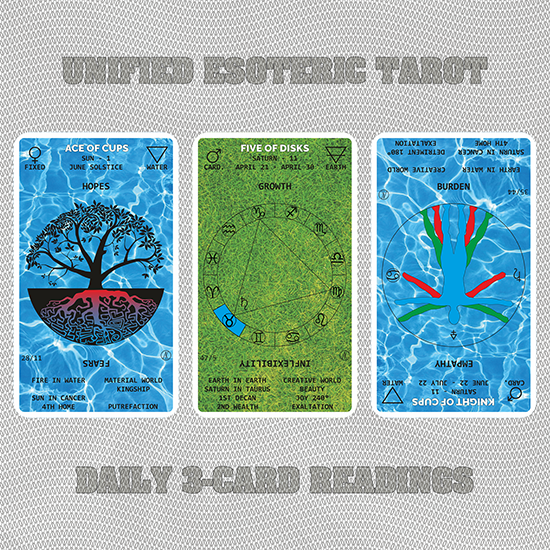
Ace of Cups – Five of Disks – Knight of Cups rev.
Hopes – Growth – Burden
Card of the day: Five of Disks
Timing:
April 21 to April 30.
3:20 AM to 4 AM.
Spiritual advice: According to Andy Rooney, everyone wants to live on top of the mountain, but all the happiness and growth occur while you’re climbing it.
Practical advice: Keep your hopes realistic and your goals achievable.
“We are products of our past, but we don’t have to be prisoners of it.”
Rick Warren
– What should you focus on today?
– What does growth mean to you?
Today’s central card promises growth.
The combination of the cards, however, is quite interesting.
The past is presented embodied by the Ace of Cups, while the reversed Knight of Cups represents the projected future.
Your hopes seem to have been justified, yet your current success may somehow become a burden in the near future.
Without basic astrological knowledge, just based on your intuition and the subjective depiction of most of the decks, we would have been stuck with this interpretation. Or worse.
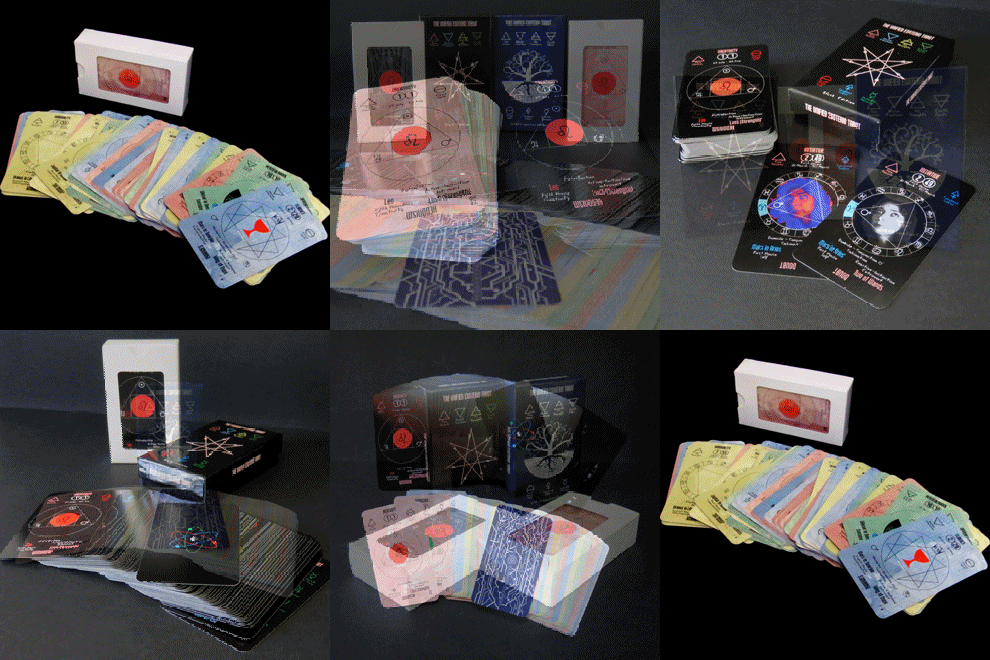
Fortunately, the Unified Esoteric Tarot provides a working astrological key that sheds further light on the circumstances.
The Ace of Cups represents the moment the Sun enters Cancer at the Summer Solstice. It’s the longest day of the year and is charged with positivity.
With the Summer solstice drawing near, I’m going to seize this chance to talk about this celestial event.
Occurring around June 20–21 in the Northern Hemisphere, this astronomical event has historically been interpreted as a moment of cosmological balance, fertility, and sacred transition. In pre-Christian Europe, solstitial celebrations were deeply embedded in agrarian cosmologies. Among ancient Germanic and Norse peoples, the festival of Midsummer was characterised by bonfires, which functioned both apotropaically and symbolically. Fire, as a terrestrial analogue of the Sun, was believed to enhance fertility, ward off malevolent forces, and ensure agricultural abundance. Participants would leap over flames or roll burning wheels down hills, ritual gestures encoding the cyclical descent of the Sun after its zenith.
In the Baltic region, particularly in Latvia and Lithuania, the solstice is celebrated as Jāņi and Joninės, respectively. These festivities synthesise pre-Christian solar worship with later folkloric accretions. Rituals include the weaving of oak leaf wreaths symbolising strength and endurance, and flower crowns associated with youth and fertility, as well as nocturnal singing and the search for the mythical “fern flower,” a legendary bloom said to appear only on this night and grant insight or fortune.
A similar tradition is preserved in Romania, with the celebration known as Sânziene. Fires are lit high on the hills, and people wrapped in wormwood belts move around the fires, then throw the belts into the fire to burn along with all the future troubles. At the end, large burning wheels are rolled, symbolising the Sun and driving away evil spirits. The Midsummer Festival is about purification, health, and new beginnings.
The Feast of Midsummer is also considered the best time to gather medicinal and magical plants. Thus, on the Night of Midsummer, women go to gather flowers and herbs, which will be used against diseases and other evils.
In some areas, it is customary to eat elderberry cake on this day. This way, you will be healthy for the whole coming year. Since ancient times, the elder tree has been planted near people’s homes because it is believed that a good spirit or fairy resides in it and protects people from misfortune.
In the British Isles, the solstice has long been associated with megalithic monuments such as Stonehenge. Archaeological and archaeoastronomical studies suggest that the monument was deliberately aligned with the solstitial sunrise, indicating a sophisticated understanding of solar cycles among Neolithic builders.
Beyond Europe, solstitial observances appear in diverse cultural contexts. Among many Indigenous peoples of North America, the summer solstice is marked by ceremonies that honour the Sun as a life-giving force. The Sun Dance, practised by several Plains tribes, is one of the most significant of these rites. Though varying in form, it generally involves dancing, fasting, and acts of physical endurance, all oriented toward spiritual renewal and communal well-being. The ritual underscores a cosmology in which human life is integrally connected to celestial cycles.
In ancient China, the summer solstice was associated with the principle of yin beginning its gradual ascendancy after reaching its lowest point, complementing the dominance of yang at the solar peak.
The Christianisation of Europe led to the assimilation of many solstitial customs into the feast of Saint John’s Day, celebrated on June 24. This strategic alignment allowed the Church to incorporate and reinterpret pagan practices within a Christian theological framework. Bonfires, for instance, were retained but recontextualised as symbols of Saint John the Baptist’s role as a “burning and shining light.” This syncretism illustrates the adaptive resilience of solstitial traditions, which persist even as their symbolic meanings evolve.
All these traditions and beliefs are channelled through the Ace of Cups, making it a quite potent card.
The present is represented by the Five of Disks, which draws its strength and meanings from Saturn’s position in Taurus. While the growth may feel slow and require perseverant effort, its steadiness is rewarding. Nothing compares to the success obtained on merit.
The interesting twist is the reversed Knight of Cups, which embodies Saturn in Cancer, completing a full circle within the three cards. Being in the reversed position, Saturn’s motion is retrograde, raising obstacles on the path of progress.
In these circumstances, the reversed Knight of Cups can be interpreted in different ways.
One explanation relates to the phrase “heavy is the head that wears the crown” from William Shakespeare’s play King Henry IV.
“Heavy is the head that wears the crown” means that those in positions of power and leadership carry significant burdens and responsibilities, often leading to anxiety and sleeplessness. The phrase highlights the challenges and pressures leaders face, suggesting that their authority comes at a heavy emotional toll.
Likewise, success comes with greater responsibility, but it also arouses envy.
In a more subtle context, burden can show a sense of guilt about being in a better situation than others and feeling like someone favoured by fate. Thus, compassion may ease the burden.
Remember this: Whoever sows sparingly will also reap sparingly, and whoever sows generously will also reap generously. Each of you should give what you have decided in your heart to give, not reluctantly or under compulsion, for God loves a cheerful giver. And God is able to bless you abundantly, so that in all things at all times, having all that you need, you will abound in every good work. As it is written:
“They have freely scattered their gifts to the poor; their righteousness endures forever.” (2 Corinthians 9:6-9. NIV)
These are general readings, and if you need answers in a specific situation, schedule a personal reading: https://tarotator.com/services/
You have access to some of these readings for free because of the generosity of all the people who support my work by joining my Patreon page: https://www.patreon.com/attilakarpathy
Learning comes with a cost.
On Saturday, you should rest.
Thus, the heavens and the earth were completed in all their vast array. By the seventh day, God had finished the work he had been doing, so on the seventh day, he rested from all his work. Then God blessed the seventh day and made it holy because on it he rested from all the work of creating that he had done. (Genesis 2:1-3)
Remember the Sabbath day by keeping it holy. Six days you shall labour and do all your work, but the seventh day is a sabbath to the Lord your God. On it, you shall not do any work, neither you, nor your son or daughter, nor your male or female servant, nor your animals, nor any foreigner residing in your towns. (Exodus 20:8-11)
#attilakarpathy #unifiedesoterictarot #tarot #threecardreading