Here is another fragment from my book, “Waiting on the Bench.”
It’s the opening part of Chapter Eighteen, not the complete chapter.
I will give you some context.
The central theme of the book is the 40 days after a man’s death.
The 40 days are a recurring theme in the Bible.
One of these occasions is the temptations of Christ.
The temptations of Jesus Christ are described in the Gospels of Matthew, Mark, and Luke. After fasting for 40 days in the wilderness, Jesus was tempted by Satan to turn stones into bread, to jump from a pinnacle to test God’s protection, and to worship Satan in exchange for worldly kingdoms. Jesus resisted each temptation by quoting Scripture.
Similarly to Jesus, Chris, the book’s central character, has to get through three trials. One of those trials is the events described in Chapter Eighteen.
Enjoy!
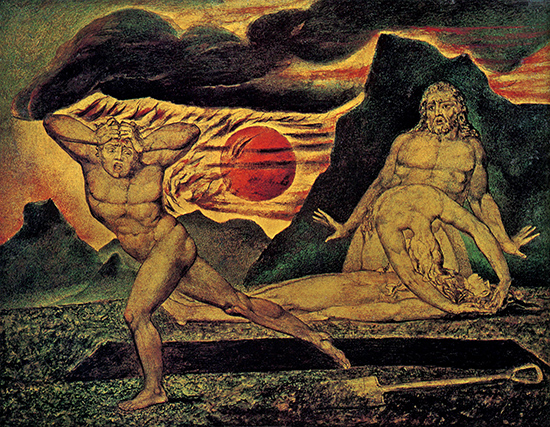
Cain and Abel (Genesis 4:1-16)
The sun had sunk almost completely at the far edge of the field, and the starless sky crushed upon my shoulders. The air turned icy instantly, and the coldness penetrated the skin, feeling like countless sharp needles. My hands felt dirty and heavy.
As I looked closely at my hands, they appeared strangely unfamiliar to me. Moreover, I felt stranger to myself, unease in my skin. It took me a couple of minutes to realise that I wasn’t myself, but Cain. Yes, that Cain. The biblical Cain.
However, if you are unfamiliar with the story, I would like to take a moment to introduce you to the subject.
There was a time, after the Garden and before the first grave, when the world was still raw, and the wind had no history to carry. Adam knew his wife Eve, and she bore a son. She exclaimed, “With the help of the Lord, I have brought forth a man.”
If you think the wording is odd, you’re probably right. No matter how chaotic things may appear sometimes in this universe, nothing is accidental.
She named her firstborn Cain.
The verb “qana” means to obtain, to acquire, or sometimes, to create, and is derived from the Hebrew word “qayin,” which can also mean “spear.”
Yet, as life frequently demonstrated, every story carries a side that remains untold. Clues, like a trail of white pebbles, but carved in words, were left in and outside the scriptures. Some have been penned, while others were transmitted by word of mouth.
Here, we will attempt to fill the gaps between the lines. Anonymous sources whispered that following the fall and the expulsion from paradise, Eve could have been seduced by the Devil. Allegedly, from their unlawful carnal intercourse, Cain was born into this world.
After a while, a second son was born, and they named him Abel, which means “breath” or “vapour,” a thing that is here and then isn’t. Nobody remarked on the name at the time. Names are like that. They wait. And after a while, some materialise, and others evaporate. It is called Magick by certain people and fate by the ignorant.
As the boys matured, because they inevitably did, they each took different routes in life, much like tree branches that extend in various directions while all seeking the warmth and blessing of the same sun.
Cain has decided to cultivate the land and work the soil.
You have to understand that these lands were arid and harsh, even hostile to anyone who sought to subdue them. It was not the gentle black loam of storybooks. Red clay split in the dry months like the skin on an old man’s heel, and in the wet months, it clung to the foot and pulled at it, as if it sought to hold on to what it received. Stones surfaced in every furrow, new ones every spring, as though the earth were breeding them in the dark. The thistles sprouted, forcing their way up with a vigour worthy of nobler causes. Thorns, too, and they had incredible stubbornness. Cut them down at the root in the morning, and by the next dusk, green nubs would push through the scar.
Cain rose before the light to meet all this. He stood at the edge of his field with the mist lying in the furrows like something that had crawled there to die, and he put his hands to the plough, and he leaned. The ground gave nothing effortlessly. Every hand’s breadth of it was a compromise, and Cain negotiated with his back and his teeth. By noon, the sun sat on his neck like a hand. By evening, his palms were split and his fingernails black with the stuff of the world, and he would stand looking at what he’d done, rows of turned earth running to the horizon like the ribs of some buried animal, and think: Mine. I made this. I made this out of nothing and spite.
And he loved it. That was the terrible thing, the thing people forget. Cain loved the field the way you love something that has hurt you and might again. He knew its moods, and knew where the water pooled and where the sun scorched. Regarding the soil, it didn’t matter whether the harvest was plentiful or everything dried up and turned to dust. It took his sweat and gave back grudging barley, and it never once, in all those years, looked up and called his name.
Abel devotedly looked after his flock of sheep.
His kingdom was the high pasture, where the wind combed the grass silver and the hills rolled away in long green swells under a sky so wide it made a man feel forgiven. He walked among his flock in the early light with the dew soaking his sandals, and the sheep came to him, they came to him, bleating and jostling, pushing wet noses into his hands.
Cain sang to them. Nobody had taught him to do so. The melodies were not learned from elders or transcribed on parchment, but were hummed into existence by the dry, whistling wind that swept across the plateau and by the birds that crested the sky.
He knew them all. This one, with the torn ear, had been a lamb born backwards in a thunderstorm, and he’d pulled her out with his arm in her mother to the shoulder, slick and shaking, and breathed into her mouth until she coughed. That one favoured her left foreleg. That ram would butt anything that moved, except Abel.
Cain would sit on the scorching rocks at midday, the stones radiating heat that blurred the horizon, looking over the flock as G_d watched over his people from Heaven.
Sometimes, with a lamb between his knees, he could feel its small heart going like a trapped bird, slowing, slowing, as it learned the shape and warmth of his hands. “Easy,” he’d say. “Easy now.”
At night, under the starry sky, he counted them by the sound of their breathing.
Here lies the difference between the brothers, plain as a line scratched in dust. Cain wrestled the world, while Abel was embraced by it.
Then came the day of the offering, when the brothers brought to the Lord what they had made.
Cain brought the fruit of the ground, hard-earned, honest fruits, in which every stalk of grain was a small victory, secured with stubborn persistence. He laid it on the altar stones and stood back with his arms hanging, his hands still stained, and waited to be seen.
Abel brought the firstborn of his flock. He chose the best of his firstborn, the choicest and fattest portions, and the one he loved most, which was the whole point. He held it a long moment, and the lamb looked up at him with perfect trust, and he whispered something into its wool that no one ever learned. Then he did what had to be done. It was not an act of cruelty, but the opposite: the highest manifestation of unconditional love. And yet, it was the most difficult thing a person could face: letting go of something they love while continuing to love that very thing just as deeply as before—offering it up with complete love in order to gain access to another kind of love, one that is superior yet volatile and, at times, impossible to perceive.
The smoke rose, and G_d looked with favour on Abel and his offering.
However, for Cain and the gift he presented, He did not.
There was no thunder, and no voice from the whirlwind. It was much worse than that. The heavens were silent. Meanwhile, the smoke from Cain’s altar sagged and lay down on the ground like a whipped dog, and the air grew close.
Cain stood there with all that labour, all those days of sweat and sleepless nights, all that red clay under his nails, and hopes he had grown in his heart. He felt the thing begin to happen inside him, the slow dark tide rising from some cellar he hadn’t known his heart possessed. A world was crumbling down unnoticed, and the clouds of a terrible storm were gathering stealthily on the horizon.
Cain was angry. Oh, he was so angry, and it showed. His face fell, and the colour went out of it, and he stood with his fists opening and closing at his sides.
And G_d spoke to him then, not unkindly, but fatherly. “Why are you angry? Why has your face fallen? If you do well, will you not be lifted up? And if you do not do well,” and here the heavenly Voice dropped, “evil is crouching at the door. Its desire is for you. But you must master it.”
Crouching. Gritting his teeth. Scratching the walls with claws curved like rusty sickles. His two pale yellow eyes were like two fading candles in the night. Evil is like a wild creature that lives on the porch in the dark, patient as the thistle, waiting for the latch to lift. Cain heard every word. That’s what makes it so hard to forgive and so hard to stop thinking about. He heard. Cain has been warned. He had one clear moment, one bright gate, and he looked at it and turned away, stepping into the abyss.
A week went by, maybe two. Cain said nothing, and the not-saying curdled in him. He watched his brother walk the hills with the flock around him like a living cloak, whistling, whistling, the golden boy, the favoured one, and a thought came to him the way a rat comes up a drain: quiet, confident, and already at home.
“Let’s go out to the field,” Cain said to Abel.
Abel came. Of course, he came. He trusted people the way he trusted sheep, not to mention, Abel had an open heart and Cain was his brother, his own flesh and blood.
The sun was setting as they walked out together under a blood-red sky. The wind dropping to nothing, the barley standing straight and still on either side as if holding its breath. Cain’s field stretched out as a menacing shadow. His kingdom of stone and thorn. Neither spoke.
Abel hummed a little, an old shepherd’s tune, until the humming died and something in the quiet told him, too late, what kind of quiet rose above them sinisterly.
He turned and saw his brother’s face.
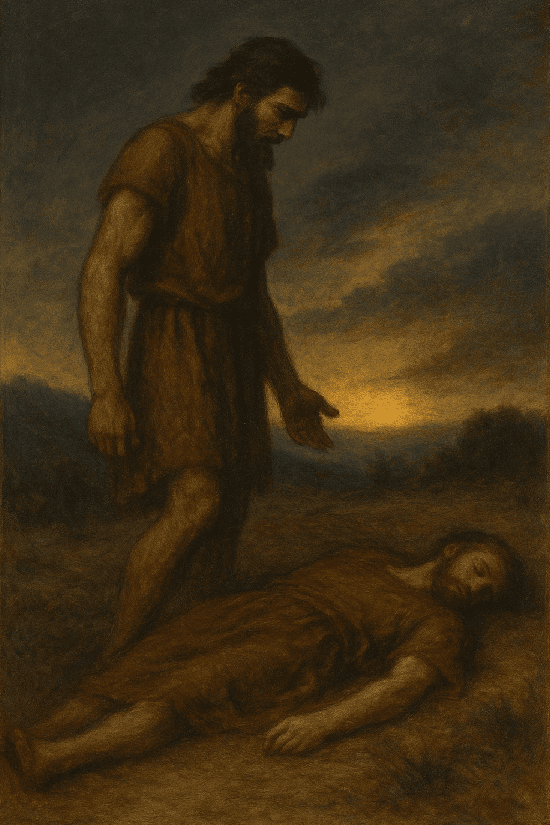
Abel did not run. That’s the detail that never leaves you. He looked at Cain the way he had looked at wounded things all his life, with gentleness, with a terrible understanding, and he put out his hand as though to calm him. “Easy,” he murmured. “Easy now.”
Abel never knew what hit him.
The ground, which had never once called Cain’s name, drank Abel’s blood.
There I was, kneeling in the middle of the field for longer than I could remember, staring at my hands stained with red clay and smeared with blood.
The wind picked up, gently, moving the barley, which whispered the way barley does, and I thought it sounded like they were talking to me for the first time. Then everything suddenly fell silent, and time appeared to freeze.
Then, the Voice from above, grave and unyielding, descended as the first, fat raindrop of a storm.
“Where is Abel, your brother?”
It was the Voice I had yearned for not long ago, but now it terrified me. The best thing that might have happened to me was if the earth had swallowed me whole, just like it drank the blood of Abel. I waited for things to pass, just as the clouds were unhurriedly drifting away from the dark sky.
“I don’t know,” I replied. “Am I my brother’s keeper?”
“What have you done?”
When it came down, I thought that I heard an echoing thunder, humming from the heavens. I realised that G_d, even in his most silent absence, was always there, watching.
“Listen. Your brother’s blood is crying out to me from the ground.”
I passed out again.
However, before moving forward, allow me to finish the story of Cain.
The soil was soaked in blood, the same land Cain had worked, cursed, loved and hated all his life. The same ground, which ignored him just as G_d disregarded his offerings, now eventually opened its mouth and spoke: “Cain.” Yet, these letters were not a name, but a curse.
“What have you done? Listen! Your brother’s blood cries out to me from the ground. Now, you are under a curse and driven from the ground, which opened its mouth to receive your brother’s blood from your hand. When you work the ground, it will no longer yield its crops for you. You will be a restless wanderer on the earth,” said the Lord.
Cain cried out, “My punishment is more than I can bear. Today, you are driving me from the land, and I will be hidden from your presence; I will be a restless wanderer on the earth, and whoever finds me will kill me.”
The Lord, after taking a deep breath, has spoken, “Not so; anyone who kills Cain will suffer vengeance seven times over.”
Then, the G_d put a mark on Cain so that no one who found him would kill him. So, Cain went out from His presence and settled in the land of Nod, east of Eden.
The biblical text does not specify what or where it was. It has been speculated that the mark was a Hebrew or Sumerian character placed on either the face or the arm.
“Nod” is the Hebrew root of the verb “to wander.” Thus, dwelling in the land of Nod may refer to living a wandering life.
There he built the first recorded city and named it after his son, Enoch. This Enoch should not be confused with Enoch, son of Jared, who is traditionally credited with writing the Book of Enoch.
There is a slight contradiction here. Was Cain a nomad who wandered the world aimlessly, running from his dark past, or did he settle east of Eden and build the first known city?
The scriptures say little about Cain and his offspring.
Cain’s descendants are listed down to the sixth generation. According to tradition, they gradually declined in moral and spiritual condition until they became completely corrupt before G_d. As this corruption spread, G_d sent the Deluge to stop evil from prevailing.
All humans alive today are said to descend from Seth, the third son of Adam and Eve.
Then again, evil has its ways. It always does, and eventually it grows back silently when and where you least expect it.
When I opened my eyes again, I realised I was no longer lying in the field torn up by the plough, but in a trench. My uniform was stained with blood and mud, and bullets and shells whizzed overhead.
(Excerpt from the book “Waiting on the Bench” by Attila Kárpáthy)
#attilakarpathy #esoteric #novel #tarot #waitingonthebench