The exact origins of the preparation period for Christmas, known as Advent, are unclear, but it was certainly established by around 480 AD. The Council of Tours in 567 mandated that monks fast every day in December leading up to Christmas.
According to Saint Gregory of Tours, the celebration of Advent began in the fifth century when Bishop Perpetuus established a period of fasting from St. Martin’s Day on November 11 through Christmas. The fast required abstaining from certain foods three times a week. Consequently, Advent was sometimes referred to as the “Lent of St. Martin.” The practice remained limited to the diocese of Tours until the sixth century.
The Council of Macon, held in 581, adopted the practice established in Tours. Soon, all of France began observing a three-day fast each week from the feast of Saint Martin until Christmas. In many countries, the most devout worshipers exceeded the council’s recommendations and fasted daily during Advent.
The theme of readings and teachings during Advent often revolves around preparing for the Second Coming and the Last Judgment.
Advent is celebrated with special masses on the four Sundays preceding Christmas.
The Four Sundays in 2025 are November 30, December 7, December 14 and December 21.
In the Roman Rite of the Catholic Church, the readings of Mass on the Sundays of Advent have distinct themes.
On the First Sunday, also called Advent Sunday, they look forward to the Second Coming of Christ.
On the Second Sunday, the Gospel reading recalls John the Baptist’s preaching, who came to “prepare the way of the Lord.”
On the Third Sunday, called “Gaudete Sunday,” the Gospel reading again concerns John the Baptist, and the other readings focus on the joy associated with the coming of the Saviour.
On the Fourth Sunday, the Gospel reading recounts events involving Mary and Joseph that led directly to the birth of Jesus, while the other readings relate to these events.
Keeping an Advent wreath is a common practice in homes and churches. The concept of the Advent wreath originated among German Lutherans in the sixteenth century.
The modern Advent wreath, with its candles representing the Sundays of Advent, originated from an 1839 initiative by Johann Hinrich Wichern, a Protestant pastor in Germany. Every morning, a small candle was lit, and every Sunday, a large candle. Modern practice only retains the large candles.
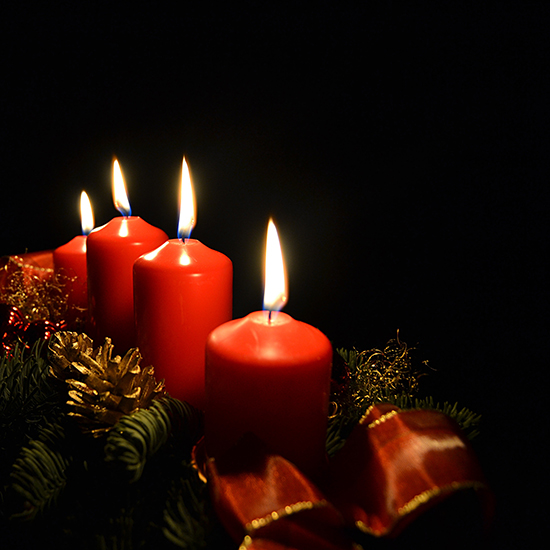
The wreath crown is traditionally crafted from fir branches, tied with red ribbon, and adorned with pine cones, holly, laurel, and sometimes mistletoe. It also serves as an ancient symbol of victory, and its round shape represents the sun and its annual return. The four candles stand for the four Sundays of Advent, while the green twigs symbolise life and hope.
The fir tree symbolises strength, and the laurel signifies victory over sin and suffering. The latter two, along with the holly, do not shed their leaves, thus representing the eternity of God. The flames of candles symbolise the approaching Christmas lights, bringing hope and peace, and also represent the struggle against darkness. For Christians, this crown is also a symbol of Christ the King, with the holly recalling the crown of thorns placed on Christ’s head.
The Advent wreath is decorated with candles, usually three violet or purple and one pink; the pink candle is lit on the Third Sunday of Advent, called “Gaudete Sunday” after the opening word, Gaudete, meaning ‘Rejoice,’ of the entrance antiphon at Mass. Some add a fifth candle, usually white, known as the “Christ candle,” in the centre of the wreath, to be lit on Christmas Eve or Christmas Day.
In Orthodox churches, there are sometimes wreaths with six candles, in line with the six-week duration of the Nativity Fast/Advent.
“Oriens” is the Latin word for “the East,” part of the Christmas tradition.
“O Oriens” is the title of an eighth-century hymn which translates to English as “For Advent.”
During the final days of Advent, December 17 to December 23, the anticipation is marked by something special in the prayers of the Liturgy of the Hours. These are called Antiphons, which are short sentences sung or chanted before reciting a psalm or canticle.
The fifth of the seven Antiphons is called “O Oriens,” and the opening verse is “O Orient, splendour of eternal light and Sun of justice! come and enlighten them that sit in darkness and in the shadow of death.” The opening “O Orient” can also be translated as “Rising Sun.”
The Twelve Days of Christmas are one of the oldest and most symbolically rich cycles in the Christian festive calendar. While modern culture often condenses Christmas into a single day of gift-giving, the traditional observance spans twelve days, from the night of December 25 to Epiphany, January 6. This timeframe evolved over centuries into a transitional period during which liturgy, folklore, and social practices intersected.
The origins of the Twelve Days of Christmas lie in the early Christian effort to harmonise various regional celebrations of Christ’s birth and the manifestation of his divinity. Western Christianity established December 25 as Christmas, while many Eastern Christian communities focused more on Epiphany as the main feast of revelation. Over time, the period between these two dates became a unified cycle, forming an extended festival that allowed contemplation of the Incarnation from different theological perspectives.
Liturgically, the twelve days were not uniform. Each day had its own commemorations, such as the feasts of St. Stephen, St. John the Evangelist, and the Holy Innocents. Together, these create a rich tapestry of narratives about faith, martyrdom, and divine revelation. The overall effect is a continuous meditation on the mystery of the Incarnation rather than just a single moment of celebration.
The Twelve Days historically served as a social interregnum beyond just religious significance. In medieval and early modern Europe, they marked a break from everyday life. Agricultural work slowed, legal activities were put on hold, and families engaged in a period of hospitality, feasting, and gift-giving.
Folklore was a significant aspect of this period. Many regions believed that the Twelve Days of festivities had supernatural qualities, with the notion that animals could speak at midnight or that household spirits became particularly active. Weather lore suggested that each of the twelve days predicted the climate for each month of the upcoming year. These beliefs highlight how the festive cycle served as a bridge between sacred teachings and the agrarian worldview. While Christianity sought to transform midwinter festivals into Christian celebrations, popular beliefs continued to support practices that predated or coexisted alongside ecclesiastical influence.
The Twelve Days served as a structured way to restore social unity before returning to regular daily routines.
#advent #christmas #attilakarpathy #esoteric