Pleased to meet you, hope you guess my name.
Especially with the twenty-two Major Arcana cards of the Tarot deck, we usually refer to archetypes. Just like the astrological attributions of the cards, these associations have changed over time. Instead of looking at these cards individually, we should adopt a general approach in which each card has a precise, stable place within a system and is defined in relation to the others.
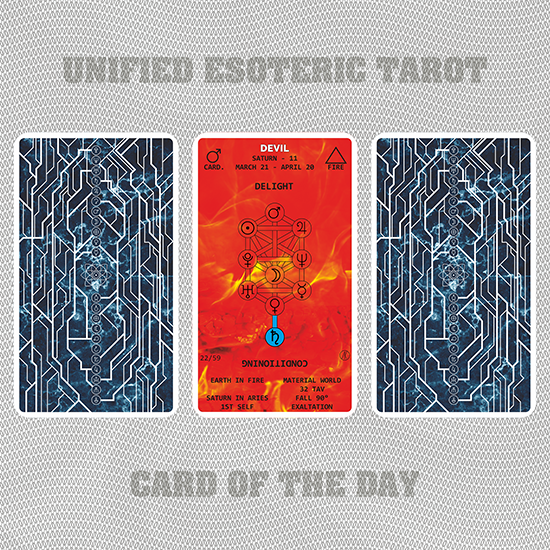
One of the most controversial archetypes is the Devil.
In contrast to ancient representations of the Devil as a serpent or dragon, Tom Ellis’s contemporary rendition of Lucifer humanises the Prince of Hell, making him both entertaining and sexy. While the theological development is undeniable, there is also an intentional, less visible rebranding of the character. It was not exclusively a shift in religious perspective, but a deliberate and programmed change in perception. Spiritually, it all started with the Renaissance, gained public attention during the late nineteenth and early twentieth century mainly due to the notoriety of Aleister Crowley, and culminated in Anton Szandor LaVey’s Church of Satan, part of a wider global movement that ranged from New Age on the one hand to Flower Power on the other, aiming at human liberation and the decriminalisation of sin. A reversal of polarities occurs at regular intervals in response to a possible natural need for renewal. The transitions are gradual and often unnoticeable. Progressively, the black becomes white, and the villain turns into a hero. A suggestive example of whitening is a Romanian saying that states the Devil is not really that black.
However, the benevolent or malevolent nature of God and the Devil is not clearly defined. Biblical scriptures depict a wrathful and vindictive Yahweh, whereas mythology presents a benevolent Lucifer eager to assist humanity.
The story of the Devil in monotheistic religious texts reflects an evolving theological understanding rather than the portrait of a single being.
Across the three major monotheistic traditions, Judaism, Christianity and Islam, the Devil evolves from a relatively low-level heavenly functionary in Judaism to a rebellious cosmic antagonist in Christianity, to a morally instructive tempter whose influence is circumscribed in Islam. These differences reflect broader theological priorities. Judaism’s primary focus is on covenant and law, Christianity’s emphasis is on redemption and spiritual warfare, and Islam’s stress is on moral responsibility and divine sovereignty.
The concept of the Devil is used to explore the problem of evil while maintaining monotheistic beliefs, serving as a unifying theme despite differing viewpoints. Each tradition handles this tension differently, but all ultimately place the Devil under G_d’s supreme authority. The Devil functions as a mirror through which each tradition explores the nature of evil, free will, and divine justice.
In the Hebrew Bible, the Devil as an independent, malevolent force opposing G_d is notably absent. Instead, the figure most inextricably linked with later notions of the Devil is “ha-satan,” meaning “the adversary” or “the accuser.” Importantly, ha-satan is a title which describes a function rather than a proper name or a specific being and denotes a role within the divine court. Thus, the role of the Devil could have been assumed by several entities at different times or under different circumstances.
The portrait of a celestial prosecutor is shaped in the Book of Job, where Satan serves as a prosecuting figure who challenges Job’s righteousness, but only under G_d’s command. In this context, Satan isn’t the origin of wickedness or in opposition to G_d. Instead, he serves as an instrument through which divine justice and human faith are tested. Similarly, in Zechariah 3, Satan appears as an accuser in a judicial context, again subordinated to divine authority.
Early Jewish theology emphasises monotheism so strongly that all power, including forces seen as harmful, ultimately derives from G_d.
Evil is thus understood less as a personal, autonomous entity and more as a consequence of human disobedience, divine testing, or cosmic balance. It’s only in later Second Temple Jewish literature, influenced in part by Persian dualism during the Babylonian Exile, that more elaborate demonologies and oppositional forces begin to appear.
Christianity inherits Jewish scriptures but radically reinterprets the figure of Satan. In the New Testament, Satan becomes a singular, named being who appears in various forms. He tempts Jesus in the wilderness, he is the “evil one” who sows corruption, the “ruler of this world,” and ultimately the dragon of the Book of Revelation.
A key development in Christian theology is the fusion of disparate Old Testament motifs into a coherent narrative of rebellion. Passages such as Isaiah 14, dealing with the fall of the “morning star,” later rendered as Lucifer in Latin, and Ezekiel 28, describing the fall of the king of Tyre, are retrospectively interpreted as allegories of Satan’s fall from heaven. The re-rendering of these themes allows Christian theologians to articulate a cosmic drama in which the Devil becomes the embodiment of pride, rebellion, moral corruption, and evil.
Unlike in Judaism, the Christian Devil is viewed as a fallen angel with personal agency, actively involved in an ongoing spiritual battle against G_d and mankind. This change reflects Christianity’s greater focus on sin, redemption, and eschatology. Evil is no longer merely a condition or consequence but is personified by a being whose eventual defeat is central to the narrative of salvation.
Islam depicts a unique yet interconnected figure in Iblis, whose story is mainly told in the Qur’an. Iblis disobeys G_d’s command to bow to Adam, claiming his own superiority as a being created from fire, in contrast to Adam’s clay. This act of defiance leads to his loss of divine grace, though he remains within G_d’s dominion.
Crucially, Islamic theology rejects the notion that Iblis is a fallen angel. Instead, he is identified as a jinn, a being endowed with free will, preserving the Islamic doctrine that angels are incapable of disobedience. Iblis does not challenge G_d’s authority; rather, he challenges humanity by attempting to lead humans astray, as his power is limited to temptation.
The Qur’an emphasises moral responsibility. Satan cannot compel sin, only tempt it. Evil, therefore, is not externalised into an overpowering cosmic enemy but remains intimately tied to human choice and accountability. The Islamic portrait of the Devil reinforces divine unity and justice, ensuring that no being rivals G_d in power or autonomy.
The depiction of the Devil in art has also evolved significantly over time, offering insights into theological beliefs, changing cultural anxieties, political landscapes, and artistic trends. From the austere symbolism of early Christianity to the psychologically nuanced, and sometimes even sympathetic, portrayals of the modern era, the Devil’s visual representation functions as a mirror of how societies have conceptualised evil. Rather than a linear progression, the transformation involves multiple reinterpretations shaped by religious authority, folklore, philosophical inquiry, and artistic experimentation.
In the earliest centuries of Christianity, there was no standardised depiction of the Devil. Christian art developed during a time when explicit imagery of evil could resemble pagan symbols or promote idolatry. Consequently, early representations of evil were minimal and symbolic instead of literal. The Devil was often depicted as a serpent, a dragon, or a shadowy figure rather than as a humanoid being. This restraint arose from a theological caution: evil was viewed more as a spiritual force than as a personalised antagonist. Artistic productions in catacombs and early mosaics focused on Christ’s triumph rather than emphasising Satan. When Satan was depicted, it was typically in narrative scenes, such as the Temptation of Christ, and he was often portrayed as a darkened angel rather than a monstrous creature.
During the Byzantine and Early Medieval Period, from the 6th to the 11th centuries, the consolidation of Christian doctrine and the expansion of church authority led to more distinct depictions of the Devil. Byzantine art, while still highly stylised, began to attribute darker colouration and distorted features to demonic figures. Black or deep blue skin tones symbolised spiritual corruption, contrasting with the luminous golds and whites used for divine figures. Yet, the Devil was still often depicted as angelic, with wings, robes, and human proportions, reflecting his origin as a fallen angel.
The High and Late Middle Ages, respectively from the 11thto the 15th centuries, mark the most dramatic shift toward monstrous imagery. As medieval Europe grappled with plagues, wars, and social instability, the Devil became a vivid embodiment of fear and moral warning. Romanesque and Gothic art adorned church portals, manuscripts, and frescoes with grotesque demons and hybrid creatures that combined human and animal traits, featuring horns, tails, hooves, and claws. These images served educational purposes in largely illiterate societies, visually communicating the consequences of sin and the reality of hell. Artists drew inspiration from pagan mythologies and local folklore, blending satyrs, goats, serpents, and dragons into a composite figure. The Devil’s body is depicted with various deformities, such as multiple faces, exaggerated genitalia, and animal-like limbs, which symbolise moral and spiritual corruption. Scenes of Hell, like those found in the tympanums of the Last Judgment, portray Satan as a devourer of souls, reinforcing ecclesiastical authority through the use of fear.
The Renaissance reintroduced classical ideals of proportion and anatomical realism, which subtly altered the Devil’s depiction. While still frightening, he often appeared more human and physically coherent. Artists such as Michelangelo and Hieronymus Bosch represent two divergent tendencies. Michelangelo’s devils in the Sistine Chapel retain muscular human forms, integrating classical anatomy into Christian narrative. Bosch, in contrast, expanded the imaginative grotesque, creating surreal, nightmarish visions filled with symbolic hybrids. The Renaissance also marked a philosophical shift: evil was increasingly explored as a moral and psychological phenomenon rather than merely a physical horror. The Devil became less a chaotic beast and a more tragic or cunning adversary, reflecting a humanist interest in the complexity of the soul.
In the 17th and 18th centuries, during the Baroque era, emotional intensity and dramatic lighting transformed the Devil into a figure of theatrical menace. Strong chiaroscuro emphasised the conflict between light and darkness, good and evil. Yet as Enlightenment rationalism spread, overtly supernatural imagery declined in prominence. The artistic focus shifted toward allegory and moral symbolism rather than literal demons. The Devil did not disappear but became less central, often relegated to literary illustration rather than grand religious commissions. Scepticism and scientific inquiry weakened the dominance of fear-based religious imagery, leading to subtler visual metaphors for evil.
Romantic artists and writers reimagined the Devil as a complex, sometimes sympathetic figure. Influenced by literary works such as Milton’s Paradise Lost and Goethe’s Faust, artists began portraying Satan as a fallen, brooding anti-hero rather than a grotesque monster. The emphasis shifted from physical deformity to emotional depth and existential rebellion. Paintings and engravings presented him as melancholic, beautiful, or intellectually defiant. This era reflects broader cultural movements that questioned authority and celebrated individualism. Eventually, the Devil became a symbol of resistance, pride, or tragic grandeur rather than pure horror.
However, not all illustrations from the era carried a romantic imprint. Probably the most influential depiction of the Devil originated from the French occultist Alphonse Louis Constant, commonly known as Éliphas Lévi, and involved another mysterious creature called Baphomet. Unlike the biblical Satan, whose imagery emerged gradually from pagan folklore, scriptural metaphor, apocryphal literature, and medieval theological imagination, Baphomet is not rooted in canonical religious texts.
The name first appeared during the trials of the Knights Templar in the early fourteenth century, when inquisitors alleged that the order was worshipping Baphomet as a demonic idol. Historians generally agree that the claims surrounding these events resulted from political persecution and coerced confessions, rather than evidence of an actual cult. However, the term continued to exist in the public consciousness, detached from any verifiable rituals and open to symbolic reinterpretation.
Éliphas Lévi, in his publications on ceremonial magic from 1854 to 1856, presented an image that would permanently reshape the figure’s identity. He depicted a winged, androgynous being with a goat’s head, a human torso, female breasts, cloven hooves, and a torch rising between its horns. The figure’s raised and lowered hands are inscribed with the alchemical maxim “solve et coagula,” which means “dissolve and recombine.” This inscription represents the hermetic principle of balance and transformation, rather than embodying moral evil. Lévi did not see this image as a literal demon or object of worship. Instead, he viewed Baphomet as a symbolic synthesis of opposites: male and female, human and animal, light and darkness, heaven and earth.
While Lévi’s drawing have been inspired by the depiction of the Devil in early Tarot decks, his illustration, especially through its reinterpretation by Pamela Colman Smith for the Rider-Waite deck, has become the standard depiction of the Devil in modern Tarot decks.
Contemporary art has fragmented the image of the Devil into abstraction, satire, and psychological symbolism. As uniform religious authority declined and secularism rose, artists felt free to reinterpret or even trivialise Satanic imagery. Expressionist and surrealist works employed demonic motifs to explore subconscious fears and societal anxieties rather than adhering to theological doctrine.
In popular culture, such as film, comics, and digital media, portrayals of the Devil vary widely. He can be depicted as a terrifying horror icon, a charismatic trickster, or even a comedic character. Contemporary art often symbolises the Devil metaphorically, using him to represent internal struggles, political oppression, or systemic injustice rather than a literal supernatural being. The visual representation may include minimalist silhouettes, ironic cartoons, or multimedia installations, reflecting a diverse range of perspectives and postmodern scepticism.
Rather than a static icon, the Devil in art is a dynamic cultural construct, continually reshaped by the fears, philosophies, and creative impulses of each age. Over nearly two millennia, the Devil’s artistic evolution moves from abstraction to monstrosity, from monstrosity to humanisation, and from humanisation to symbolic multiplicity. The image of the Devil ultimately reflects humanity’s changing understanding of evil and of itself.
The Devil exists independently of human belief. While religions theorise the nature of evil and try to identify its place within the universe of G_d and the human heart, its presence and manifestation are undeniably real and observable, occasionally exceeding human wickedness.
You can mock the Devil, don’t believe in the Devil, but you can’t deny the existence of evil in the world.