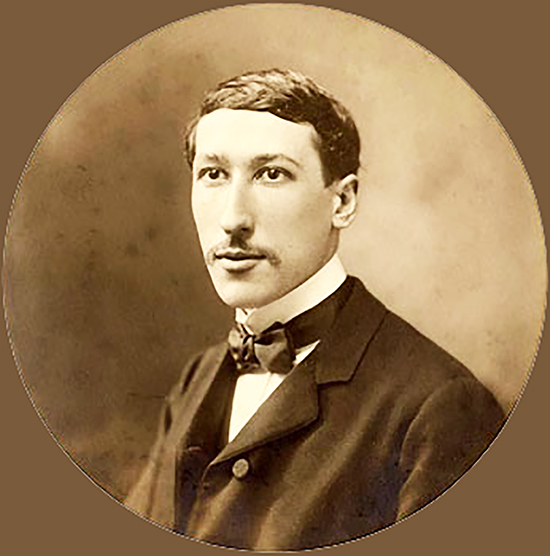
I read multiple books simultaneously. I usually have a pile of 10 to 12 books that I read from randomly. In the current pile, one book is René Guénon’s The Crisis of the Modern World (La crise du monde moderne), originally published in 1927.
René Jean-Marie-Joseph Guénon was a French-Egyptian intellectual who wrote on esoteric topics. He was born in 1886 in Blois, France, into a Roman Catholic family. By 1904, Guénon was living in Paris as a student, where his studies focused on mathematics and philosophy.
Guénon became a student of Papus and was also involved with the Esoteric Christian Martinist order, which was supervised at the time by Papus. He also joined the Gnostic Church of France, founded by Léonce Fabre des Essarts. Eventually, he was initiated into Islamic esotericism as early as 1910.
The Crisis of the Modern World was written in dark days, in the aftermath of the First World War, and it’s a metaphysical diagnosis of what Guénon considered a terminal civilisational disorder. Guénon’s framework is explicitly anti-modern. However, his critique does not operate at the level of policy, economics, or cultural taste, but it’s rooted in metaphysics.
Guénon argued that modern civilisation is structured horizontally, privileging quantity over quality, and the shift from qualitative to quantitative understanding marks a descent into spiritual ignorance. Thus, modernity is not progress but degeneration.
One of Guénon’s most provocative claims is that modern civilisation represents an inversion of the natural order. Democracy and egalitarianism are criticised not primarily for political reasons but because they flatten ontological hierarchies. Equality, according to Guénon, is metaphysically absurd because individuals are different by definition.
Guénon also interpreted modernity through the Hindu doctrine of cosmic cycles, particularly the Kali Yuga, the “Dark Age.” He does not present decline as accidental but as cosmologically inevitable.
The universe is governed by several cycles. There are planetary cycles, and the eras can be calculated in various ways. Additionally, other cycles can also be identified and calculated. However, one of the major risks is finding patterns in everything, even where there are none.
Kali Yuga is the fourth and current age in Hindu cosmology, characterised by conflict, sin, and moral decline. It began around 3102 BCE and is believed to last for 432,000 years, with approximately 426,873 years remaining as of 2026.
Guénon didn’t offer a reformist program, and he rejected political activism as superficial. However, he saw in Islam a spiritual path that might represent an alternative to the Western spiritual and material decay.
Islam is the third and most recent of the Abrahamic monotheistic religions. Although it was established after Christianity, in many respects it signifies a return to more primitive traditions, some rooted in Judaism and others in pre-Abrahamic religious and cultural practices.
Things must be seen in context. The horrors of the First World War left deep wounds that most people thought were irreparable. Considering the historical timeline, Islam might be interpreted as an evolution of Christianity. Likewise, Oriental spirituality might have been seen as a viable alternative to Western decay.
However, I don’t share Guénon’s enthusiasm regarding Islam. I do not dispute its potential spiritual virtues, as every religion contains valuable teachings. What I find objectionable is its severe intrusion into the organisation of both private and social life, and the subjugated role designated to women. Therefore, Islam encompasses more than a religion; it is a comprehensive religious, political, and social system, incompatible with democracy.
Organised religions are sophisticated forms of matrices. René Guénon might have considered Islam a better alternative to Christianity, yet changing one matrix for another will never fix the fundamental issue: you are going to stay a prisoner.
Currently, Western civilisation is facing greater challenges than at the end of the First World War.
Ironically, especially in Europe, one of the threats is exactly Islamisation. I’m afraid it’s not the Islam as René Guénon imagined it.
Globally, the conflict between “good” and “evil” is debated between those who identify as progressive globalists and those who identify as conservatives.
Globalists promote the climate change agenda, gender identity, and emphasis on minority rights, such as issues regarding the LGBTQ+ community. Awkwardly, the globalist left combined the unthinkable: Islam with LGBTQ+, at least at a propaganda level. It’s just as natural as same-sex marriage.
Don’t get me wrong. I am not homophobic, nor Islamophobic. I met both great gay people and Muslims. Being a good human being is genderless and unrelated to one’s beliefs. However, the LGBTQ+ propaganda is toxic, and radical Islam is dangerous, as any intrusive religion is.
In response, conservatives promote Christianity, traditional family values, and capitalism.
Christianity, like any religion, has both qualities and flaws. In Europe, it kept Islam at bay, creating a framework favourable to civilisation, but it also had its dark aspects, such as the Inquisition and Christianisation by the sword. Paradoxically, it had both a civilising and oppressive influence. Its institutional form has little to do with the original teachings of Jesus.
Both socialism and capitalism failed, and democracy has been corrupted.
Western civilisation is in decline socially, morally, economically, politically, religiously and spiritually.
Globalists are neo-liberal socialists, often with a radical left-wing agenda, while conservatives are mainly capitalists with centre or right-wing sympathies. Both orientations have proven their shortcomings and their inability to provide viable solutions for genuine progress and prosperity for humanity.
The constant battle between “good and evil” is nothing but the good-old method of divide and conquer. At the end of the day, we all have to lose, while someone, somewhere, has a good laugh.
From the point of view of the Matrix, can Christianity be the counter-response to progressive globalism? Is one imprisonment better than the other?
A lie is still a lie, even if everyone believes it.
The truth remains true even when nobody accepts it.
Enlightenment, which basically means awakening, is an individual choice, yet it requires a collective effort. One can hardly awaken by themselves and stay awake.
We are at a dangerous crossroads, both individually and collectively.
Individuals may, occasionally even by accident, slip through the cracks, but there is no collective escape by accident. The paradox lies in the fact that widespread enlightenment cannot occur without personal enlightenment, yet individuals are the least receptive to it.
#attilakarpathy #matrix #esoteric #thoughts #enlightenment